

The difference between moxibustion therapy and 810nm, 980nm, and 1064nm laser therapy
Moxibustion lamps (usually referring to infrared therapy lamps) and 810nm, 980nm, and 1064nm laser therapy are two completely different physical therapy methods. They differ significantly in principle, depth of action, biological effects, and applications.
Key Summary
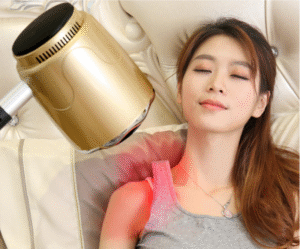
*Moxibustion Lamp (Infrared Therapy): Essentially surface heating. It raises tissue temperature by radiating infrared rays, belonging to a therapy primarily based on thermal effects. Its effects are relatively superficial, mainly aimed at promoting blood circulation and relieving muscle spasms and pain.
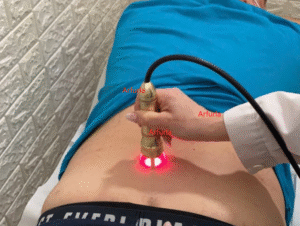
*Laser Therapy (Photobiomodulation Therapy):Essentially a photochemical effect. Specific wavelengths of laser light penetrate tissue and are absorbed by cells such as mitochondria, triggering a series of photobiological reactions. Its therapeutic effects do not rely on obvious heat sensations. It acts at a deeper level, aiming to regulate cell function, promote repair, and reduce inflammation.
Moxibustion Lamp:
Basic Principle: Thermal radiation principle. It emits a broad spectrum of far-infrared or mid-infrared rays (typically with wavelengths above 2.5μm), which are absorbed by water molecules in the skin and superficial tissues, converting into heat energy.
Core Effect: Primarily thermal. It works by increasing temperature.
Depth of Action: Relatively shallow. Mainly concentrated in the skin, subcutaneous tissue, and superficial muscles. Heat energy can be conducted to deeper tissues, but the core effect remains superficial.
Biological Effects:
- Promotes local blood circulation (thermal expansion and contraction).
- Relieves muscle spasms.
- Enhances tissue metabolism.
- Calms and relieves pain (primarily through heat masking and relaxation effects).
Main Applications:
- Muscle strain, stiffness
- Chronic arthritis (symptom relief)
- Cold-dampness arthralgia (Traditional Chinese Medicine category)
- Post-exercise relaxation
810nm / 980nm / 1064nm Laser Therapy
Basic Principle: Photobiomodulation. Emits a single wavelength (monochromatic) laser:
- 810nm: Considered one of the optimal “treatment windows,” strongly absorbed by cytochrome C oxidase, resulting in significant photobiomodulation.
- 980nm: Primarily absorbed by water, therefore its thermal effect is more pronounced than 810nm, but its penetration remains good. Often used in scenarios requiring both photobiomodulation and mild thermal effects.
- 1064nm: Deepest penetration depth, less absorbed by tissue components, allowing for more effective access to deep tissues such as joints and deep muscles.
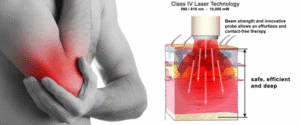
- Core Effect: Primarily photochemical effects. Even at very low power (cold laser), it can be effective by modulating cell function. High-power versions are accompanied by thermal effects.
Depth of Action: Relatively deep. The monochromaticity and coherence of the laser enhance its tissue penetration.
1064nm > 980nm ≈ 810nm (penetration depth ranking in soft tissue). 1064nm can effectively target joints, deep tendons, and ligaments.
Biological effects:
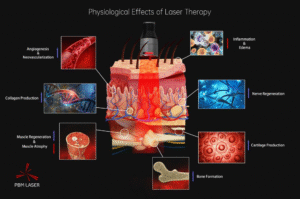
- Promotes ATP synthesis: Enhances cellular energy.
- Regulates reactive oxygen species: Exhibits antioxidant and signal transduction effects.
- Promotes blood circulation (through the release of vasoactive substances such as nitric oxide).
- Anti-inflammatory effect: Reduces pro-inflammatory factors.
- Promotes tissue repair and regeneration: Stimulates fibroblasts and collagen synthesis.
- Nerve repair and analgesia: Regulates nerve excitability.
Main applications:
- Soft tissue injuries: Tendinitis, ligament sprains, muscle strain (accelerates repair)
- Arthritis: Especially deep joint inflammation (e.g., knee arthritis)
- Neuropathic pain: Such as trigeminal neuralgia, postherpetic neuralgia
- Wound healing: Difficult-to-heal wounds, ulcers
- Postoperative recovery: Reduces edema and pain(Another special application is its use after endolifting treatment, where the effect is even better.)
- Sports medicine: Used for rapid recovery and performance enhancement
How to Choose?
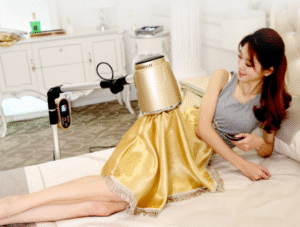
Choosing Moxibustion Lamp (Infrared Therapy): For those seeking comfort and relaxation: You desire a warm, soothing experience to relieve daily muscle fatigue and stiffness.
For those with pronounced cold symptoms: According to Traditional Chinese Medicine theory, heat therapy can provide direct comfort for pain and aversion to cold caused by “wind-cold-dampness syndrome.
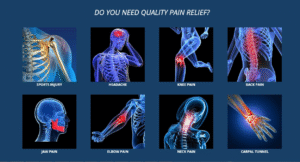
Choosing Laser Therapy (especially 810nm/1064nm): For those with confirmed inflammation or injury: Such as diagnosed tendinitis (tennis elbow, Achilles tendinitis), ligament injuries, synovitis, etc., laser’s anti-inflammatory and repair-promoting abilities are more targeted.
For those needing treatment for deep tissue problems: Such as knee arthritis, deep hip muscle problems, frozen shoulder, etc., the deep penetration advantage of 1064nm laser is significant.
For those seeking a more “fundamental” treatment effect: You are not satisfied with merely relieving symptoms, but hope to promote tissue self-repair at the cellular level and shorten the course of the disease.
For those sensitive to heat or unsuitable for heat therapy: If the affected area has acute inflammation, fever, or you are intolerant to heat, a non-heating or slightly heating laser is a better choice.
In totally, Moxibustion lamps act like “heat lamps,” providing comfort through heat and primarily used for relaxation and relieving symptoms of coldness.
Laser therapy, on the other hand, acts like a “cell charger,” delivering energy to cells through specific wavelengths of light. This initiates repair and anti-inflammatory processes at the cellular level, directly targeting the root cause of the problem for a deeper and more precise effect.
To get more information:
https://www.instagram.com/zwkayla_arfurla_lipolysis/
https://www.facebook.com/profile.php?id=100081991205305
Web:www.arfurlamed.com/www.arfurla.com
Whatsapp:+86 15857812810
Email:kayla@arfurla.com/zwkayla@outlook.com
Wechat:zw3262526419